token-2022 · solana · program-claimed fee stream
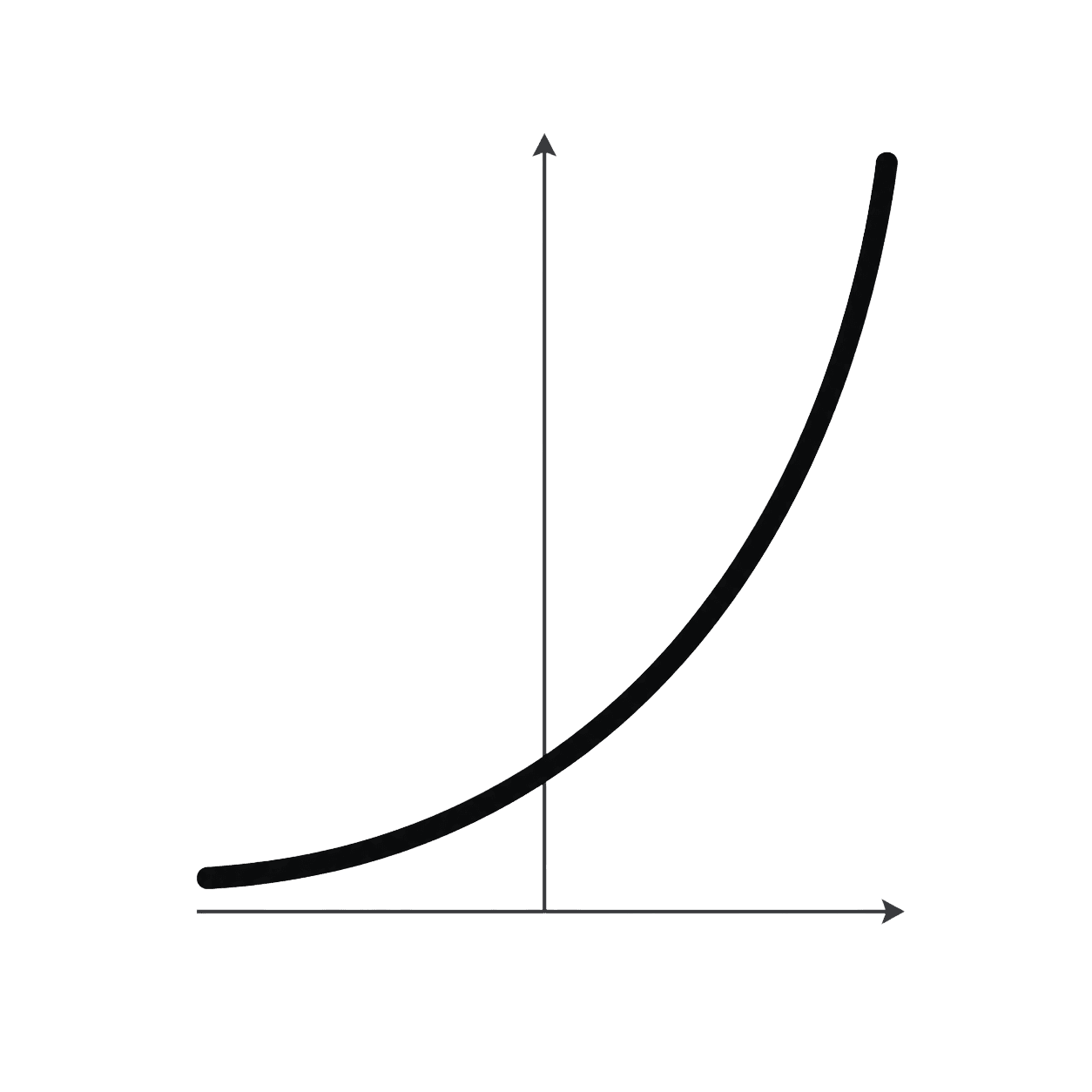
y=bx
the exponential curve
the floor under this token is a ratchet.
a program intercepts the fee stream from every trade and puts it to work in two places — half stands as a bid beneath the market and burns what it fills, half sits in a reserve any holder can draw against, pro rata.
the floor plotted against the order flow that builds it. the upper trace is the reserve leg of the fee take divided by circulating supply, accumulated bar by bar across live traded volume — it has no downward step because nothing in the arrangement removes from the numerator. underneath, flow separates by direction: buy-dominant bars above the baseline, sell-dominant below. quantities only the program can report sit in a loading state until it is live.
premise
Creator fees on a bonding curve are ordinarily a private revenue line. Here they are intercepted at the point of accrual by a program and never arrive at a wallet. Each claim divides on a ratio fixed at deployment — 50.00% into a bid that buys the token back and destroys it, 50.00% into a reserve that collateralizes redemption — and both halves are spent on the token rather than on anybody.
What falls out of that arrangement is a floor: reserve balance over circulating supply, denominated in SOL. It is arithmetic over two account balances, which means anyone can recompute it at any block without trusting a dashboard, this one included.
the split
Trading generates creator revenue in SOL. The program claims it and routes it, inside the same transaction, into two accounts. Neither leg pays a person, and the ratio is not a dial anyone turns afterwards.
  bid_leg     = c · 0.50
  reserve_leg = c · 0.50

  R  ← R + reserve_leg
  B  ← B + bid_leg
Tokens issued against the curve land in every wallet in proportion to what that wallet already holds. The consequence is worth stating precisely, because it is the part most easily oversold: scaling every balance by the same factor leaves every share of supply exactly where it was, and therefore leaves every claim exactly where it was. Issuance distributes. It does not manufacture backing. Backing arrives through the reserve leg and improves through retirement.
the floor
Hold h tokens against a supply of S and you own h/S of a reserve holding R. Redemption pays out that fraction in SOL and destroys the tokens presented for it.
floor = R / S

claim(h) = (h / S) · R
exiting takes nothing
The usual complaint about a redeemable claim is that whoever leaves first leaves carrying something that belonged to everyone. Not here. Burning k pays k·R/S and removes k from supply, shrinking numerator and denominator by an identical factor. The quotient does not move.
redeem k:

  R' = R − kR/S
  S' = S − k

  R'/S' = (R − kR/S) / (S − k)
        = R(S − k)/S / (S − k)
= R/SWithholding part of the payout turns invariance into growth. At f = 3.00%, the redeemer leaves with (1−f)·k·R/S and the difference stays behind in an account now divided among fewer tokens. Everyone who stays is strictly better off for someone else having gone.
redeem k, withhold f:

  R' = R − (1−f)·kR/S
  S' = S − k

  R'/S' = (R/S) · (1 + f·k/(S − k))

  1 + f·k/(S − k) > 1     for 0 < f ≤ 1, 0 < k < S
the bid gate
The bid leg puts reserve-adjacent capital into the open market, which cuts both ways. Retiring ΔR/P tokens for ΔR of SOL moves the floor in a direction determined solely by where the fill price sits relative to the floor itself.
spend ΔR at price P, burn ΔR/P tokens:

  floor' = (R − ΔR) / (S − ΔR/P)

  floor' > floor   ⟺   P < R/S

with u = ΔR/R and m = floor/P:

  floor'/floor = (1 − u) / (1 − u·m)
Most buyback programmes never state that condition, which is exactly why they leak. Encoded as a precondition the program verifies rather than a judgement somebody exercises, it turns the allocation into a standing bid underneath the market: below the backing the program is a buyer and every fill tightens supply for everyone still holding; above it the program does nothing at all and the allocation waits. An idle bid balance is the expected state, not a fault.